

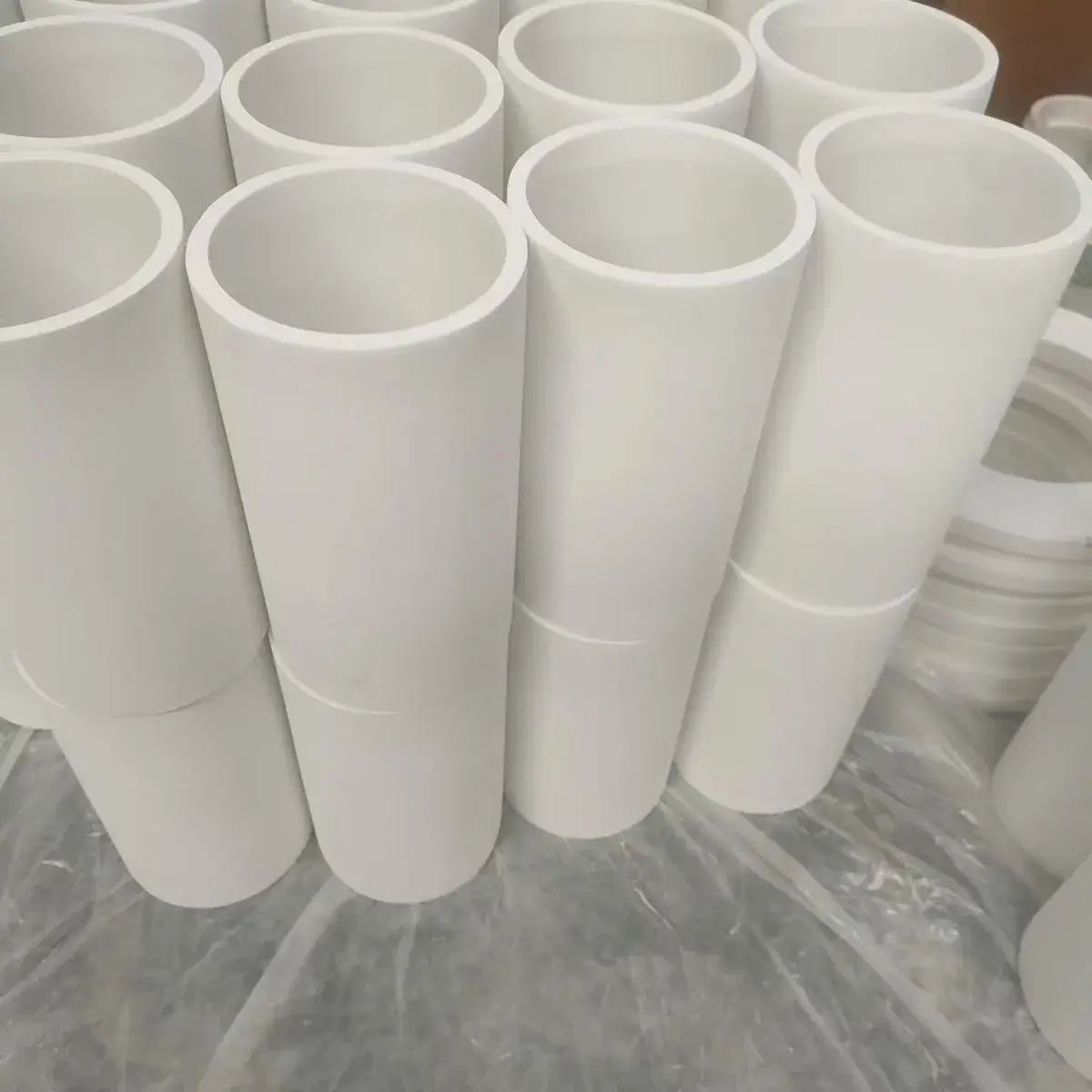


Zirconia Toughened Alumina (ZTA) Ceramic
Zirconia Toughened Alumina (ZTA) is a composite ceramic material produced by introducing zirconia (ZrO₂) particles into alumina (Al₂O₃).
Through a phase transformation toughening mechanism, ZTA significantly improves the toughness and impact resistance of conventional alumina ceramics while retaining high hardness, high-temperature resistance, and corrosion resistance.
It is a representative high-performance structural ceramic.
Performance Parameters
| Parameter | Value |
|---|---|
| Density | Approx. 4.0-4.3g/cm³ |
| Vickers hardness | Approx. 16.0GPa |
| Three-point flexural strength | 600-705MPa |
| Young’s modulus | 330-380GPa |
| Poisson’s ratio | 0.24-0.25 |
| Average linear expansion coefficient (40-400℃) | 7.2-7.8x10⁻⁶/K |
| Average linear expansion coefficient (40-800℃) | 8.2-8.7x10⁻⁶/K |
| Thermal conductivity (20℃) | 16-26W/m·K |
| Specific heat capacity | Approx. 0.71J/g·K |
| Flexural modulus | Approx. 260GPa |
| Max. service temperature | Approx. 1400℃ |
| Thermal shock resistance | Approx. 325℃ |
| Volume resistivity | >10¹²Ohm·cm (100V) |
Performance Advantages
-
High strength and hardness
Flexural strength up to 400-600MPa (compared with approximately 300-400MPa for pure alumina) and Vickers hardness HV10 ≥1300, suitable for severe wear applications.
-
Excellent corrosion resistance
Acid and alkali resistance comparable to pure alumina and superior to metallic materials.
-
Thermal stability
Service temperature up to 1600-1700℃, with a linear thermal expansion coefficient close to that of metals (6-8x10⁻⁶/℃), facilitating integration with metal components.
Applications
- Wear liners, nozzles, and ball valves for mining and chemical industries
- Substrates and packaging housings in electronic ceramics
- Bearing balls and sealing rings for high-speed rotating equipment, such as mechanical seals for pumps
- Ceramic rollers and grinding media in lithium battery production
- Corrosion-resistant filtration components in wastewater treatment
- High-temperature structural components for aerospace applications, such as engine thermal insulation parts
- Precision positioning components in semiconductor equipment, requiring low impurity levels and high electrical insulation